Showing posts with label discussion. Show all posts

Tuesday, August 4, 2026

Discussion on Tactics At Aether Salon


By Bixyl Shuftan

This is one of my "better late than never" articles that temporarily got lost in the reporting about the SL23B and then Rita Mariner's passing. 

Besides being the last day of the Second Life Birthday, Sunday July 19 was also the day of July's Aether Salon discussion. 

Today at 2PM SLT: The Aether Salon presents TACTICS! with one of the founding Salonistas, Jedburgh Dagger. Sneak in unnoticed, steal a seat and brace yourself for further instructions.   

One of the central points of the discussion by Jedburgh Dagger of tactics was what face a commander on the field: "the three 'Cs,'" Command, Control, and Communications."Command, go there. Control, stay together. Communications, tell them to go there too." And in ancient times with no radio, communications wasn't easy, relying on visual signals, horns, and messengers which took time to reach where they were going and vulnerable to being killed. 
 
 
Jedburgh noted that tactics pretty much stayed the same for millennia. Even when firearms first appeared in European battles in 1419, they weren't a significant change at first, until "in 1525 the first battle that was pivotally decided by firearms was fought in Italy. Battle of Pavia, when the cavalry found out that you can't run pell mell at a block of musketeers. But even so, guns ended up not changing the formations a great deal."

Real change would have to wait until King Gustavus Adolphus of Sweden, "known as the first modern general, and the man who started the widespread use of 'combined arms'.What he did was use cavalry, artillery, and infantry together, each using their strengths to offset the weaknesses of the other."  

Still, the practice of men in lines marching in formation toward each other continued, even in the early and mid 19th Century that saw developments in firearms and ammunition that made rifles more accurate and quicker to reload. But then came Maxim and his machine gun, "it took Maxim's gun to provide huge amounts of fire that ended the large unit use of line formations, and also killed colored uniforms for that matter." But line formations didn't go away entirely, "even today, the riot squad and the infantry squaddie still do the same thing their Greek ancestors did."
 
There were some amusing moments with the occasional joking remark, such as someone responding to the comment "the same thing their Greek ancestors did" with Tepic Harlequin going "drink too much and fight the locals?" He would also man the machine gun on display. There were also fireworks unleashed at one point. 
 
Ceejay Writer, who organizes Salon events, would say, "we do not have a speaker for next month, but we do for the rest of the year," and invited people to sign up to be one.  
 
The Aether Salon discussions are announced in the New Babbage group inworld, and on it's Discord. They take place at Babbage Canals (195/63/105).
 
To read the group blog, including this week's transcript, Click Here: https://aethersalon.home.blog/
 
Bixyl Shuftan 


Monday, May 25, 2020

Discussion On Alcoholism In The Coronavirus Crisis


By Bixyl Shuftan

On Thursday May 14, Virtual Ability held a discussion about how the Coronavirus Crisis is affecting those suffering from alcoholism. It took place in the Sojourner Auditorium. Titled "Strange Days Indeed," the event was part of their "Mental Health Un-Conference." Coughran Mayo (Dick Dillon in real life) spoke to the audience while Elektra Panthar provided the transcript for those not using Voice.

Coughran, whose avatar was wearing a mask, described himself as taking a balanced approach when going outside his home, such as washing his hands a lot and avoiding poker games, "it's not safe with the cards and chips." While it might seem funny that many places had closed restaurants while allowing liquor stores to remain open as "essential," he stated that that along with the stress of the Pandemic was allowing those whom had overcome addiction to relapse. "In this time stress, economic uncertainty are high, lack of scrutiny of normal social life - they are all factors that increase the chance of addiction and relapse Alcohol, prescription or illicit drugs -many people are likely to become addicted, and the problem is that the traditional way to help is not available at the moment." It was also commented that some treatment groups could end up shutting down due to the effects of the crisis, such as lack of donations as people's incomes and savings suffer.

There was plenty of feedback. Someone commented that it might be that borderline alcoholism from social drinking might decrease from people not able to go to the bar as they used to. Similar with compulsive gamblers, whom if they couldn't or wouldn't go to virtual casinos would find it hard to make bets. There was also the question if people with disabilities were more likely to develop addictions, particularly those on medications as mistakes could easily be made with dosage.

Another question was could more people find treatment in virtual reality, as some were getting it here already? It was commented that thanks to bad press, Second Life didn't have the best of reputations, and that Twitch still bans broadcasts from the virtual world doesn't help matters.

At the end, Gentle Heron thanked Coughram for the event, and the audience for attending.

For those whom want to read the transcript:  Click Here.

To check more about Virtual Ability, check out their website: https://virtualability.org/ .

Bixyl Shuftan

Monday, November 12, 2018

CDS Election Campaigning: Drewski Northman


By Bixyl Shuftan

Different communities have different ways of how things are run. For the Confederation of Democratic Simulators, the community has elections twice a year in which local citizens (those who own land in the community) chose who will be in the Representative Assembly and who will be their leader: the Chancellor. This election, two people are running for Chancellor. They are Drewski Northman, and 恭子 Kyoko (Samara Barzane).

Sunday November 11 saw two events in which both candidates had a chance to explain themselves to the voters. At 11 AM, Drewski Northman at the Sanctum Sanctorum in Colonia Nova.


For those of you that could not attend today, I will be hosting another event at the Sanctum in Colonia Nova tomorrow at 11AM. Come to my home in the CDS, the Sanctum Sanctorum for a campaign speech and meet and greet. I'll be speaking on building the community, and my plans for outreach. There'll be a short Q/A to follow. Then we can all walk down to the amphitheater to enjoy the Autumn Dances event!


Drewski greeted those dropping in, "Thank you for coming to my first "formal" campaign rally! This building is near and dear to me, as it's been my home in the CDS for over 2 years. Before I say a few words, I'd like to take a moment of silence to commemorate today's 100th anniversary of the end of World War 1. Without the sacrifice of those brave men all those years ago, we would not have a free Europe or America today, or the ability to enjoy this SL world."

Drewski told everyone there would be a transcript made of the event, then, "Now, I'd like to say a few words before opening up to questions and discussion... I've been a citizen of the CDS for just over two years now, so happy to call it home. It was a safe harbor after leaving the turmoil of another community shutting down. That alone would be enough for me to want to give back to this community by serving. But, there's been so much more since then. It's been a place where I could express myself with this Sanctum Sanctorum. Some of my finest friends in all of my Second Life are here (and sitting in the room today), and I love participating in the civics and democracy. And now, I have the privilege of running for chancellor. I do not take that lightly. It's an honor to have the opportunity, and I hope that I can help this community enter a bright future of prosperity, unity...and fun! That is the whole essence of my campaign, 'A New Dawn.'

"Today, I just want to briefly discuss some plans for my first priority: building the community. I believe we can accomplish that in a two-pronged way: outreach and unity. With outreach, I believe there's more to it than just filling vacant plots of land or houses in NFS. We have to sell the ideals of this community, sell the dream. We already have ads playing on Radio Riel. I would continue that practice, and go even farther in promotional efforts. There is also a group that is for advertising events all through the steamlands, called 'Aether Chrononauts.' As far as I know, we do not currently advertise there. I'd seek to put our group's events and activites there. I would also seek to revitalize some events that have gone by the wayside. I've already heard of holiday decorating contests, parades, festivals that have for one reason or another fallen by the wayside. I think those are fantastic draws to our community that prove we are active and fun.

"Also, something that was mentioned to me this last week that really struck me. If elected, I would seek to form an official welcoming committee to engage with new citizens. A resident told me last week that she has been here since June, and has not really been welcomed yet. We should be the most welcoming and inclusive community on the grid. And to piggyback on that idea. I would also seek to set up a monthly "New Citizen Mingle" where community members new and old, and our valued friends can casually get together, meet, and strengthen those community bonds.

"Which brings me to my second prong of building our community: unity. It's no secret that our community has a....rocky reputation in the greater world. Sadly, we have had some issues that have made good, involved, solid citizens pack up and leave. And I believe those events have also caused good, solid, potentially involved people to steer clear of us as well. Folks...it's a new day in the CDS, and I propose we need to come together as a community, heal, and move past the drama and contention of the past. I can't change attitudes alone, but I believe that a determined effort of an administration and community can change the attitude and direction that community heads. I think its high time we as a community would take a stand against the childish, dramatic things that have happened in the past, and commit that we aren't going to tolerate those attitudes going forward. That is my pledge if you will allow me to serve as chancellor. I believe that our best days lie ahead. I know I have dreams of seeing this place full of people, seeing folks involved in our democracy, and seeing all of us come together as a tight-knit community focused on enjoying this world together. That is my plan to build our community."

Drewski then offered to take questions, "We have about a half hour or so before the next event, so I'll open the floor for questions, comments, discussion, ideas." Tanoujin Milestone was the first to do so, "First of all I want to thank you for running, this makes this a true election with a real choice, and that is much needed. Thank you Drew for standing! ... Another thing I would like to mention: what ever happens, I like the idea of reviving a welcome committee and I am looking forward to the results you may have with this  no matter if you become the first or the second winner of this election. You will have surely my support with the welcome committee. Thank you, (I'm) done." Drewski responded, "Thank you! I do hope it's something we can work together on reviving, no matter what. Folks need to feel welcomed and involved."

Lyubov (20180414 Resident) was next with two questions, "This room today is full of people who have proven their dedication to CDS.  Most of the 29th RA is sitting here as well as the most recent Dean. If elected, your first term would be a fast six months. First, what, specifically, would you like to focus on?  What one thing, if accomplished, would you define as success? Second, what time committment would you ask of us, members of various committees, to contribute on a monthly/weekly/daily basis?  How much time do you expect the job of Chancellor to require?  What would you ask of all CDS citizens? (I'm) done."

Drewski responded, "Great questions! First, my priority is growing and strengthening our community. The things I discussed today are priority number one for me. I may be imagining, but it seems like the CDS has fallen into a bit of a rut. I'd aim to help us out of it. I would call success seeing these sims full of green (or better yet...yellow) dots, people just 'being' here, using the facilities to enjoy their SL." Lyubov smiled, "It would be nice to not be alone here 90% of the time." Answering the second question, Drewski spoke, "And, as for time commitments, I'd say this. I don't really know the best answer for each individual. I would hope that (real life) comes first for everyone here, but that all those that choose to serve will do their very best to fulfill their duties. If that means 3, 4, 5, 10 hours...it all depends. All I ask for is folks do their best. That is my commitment, and I can't ask any more of anyone else."

Lyubov. asked, "What about you personally? Is this an hour a week, hour a day job?  I don't know..." Drewski answered, "Me personally? I plan to do whatever it takes to accomplish my goals for the community, holding regular office hours, meeting with the RA, networking with other community leaders to cross promote our community... I'll be working hard." Lyubov told him, "Thank you.  done (again)."

Tanoujin then asked, "May I ask who will be on your team, as the PIO for example?" Drewski answered, "If I win, I would ask Kyoko to stay on as PIO if she wanted. I think she is doing a great job, and has brought some unique events to the CDS this year. Also, Lyu and I have had many conversations about outreach, getting folks excited, and building the community. I know she would be a great addition to our team as well."

Lyubov smiled, "I would love to help in any way that I can, thank you." Drewski went on, "Yeah, its funny. We've been chatting about these things for a couple months now, long before I even thought of running for chancellor. I think folks have a real hunger to see this place grow and shine."

Drewski checked the clock, "We've got about 10 minutes left. Time for 2-3 more questions if you have 'em." Tanoujin asked, "Hm, I am wondering what measures you would take against drama.... I hope you would stick to the road of de-escalation instead of excluding?" The candidate answered, "I think there's a few steps the Chancellor can take. For one, I would pledge to deal with any issues privately first, one on one. Yes, I agree on the principle of de-escalation and just...talking. We can't shoot first and ask questions later. Though, its not something you can really legislate against. I think that if the attitude of the majority in the community is 'we ain't got time for that,' the drama llamas will catch on real quick and find someplace else to cause trouble. But if trouble arises, I believe the best policy is to deal with it quickly and quietly, less attention the better."

Lyubov then asked, "In your experience as Community Manager for the East River Community, what was the most important thing you learned?  What was your biggest mistake?  Done." Drewski answered, "The most important thing I learned is you cannot do things alone. We had so many opportunities there to make the place thrive. I was regularly running events and bringing in new residents. We even were featured on Designing Worlds. But a year or so later, the place was in danger of shutting down, because the main land owner was pulling out. That was after she put a wet blanket on many attempts to do things to draw people in. So...it takes a committed group to make a difference." Lady Kiki Whatever (InekeB Resident) wondered, "East River Community? Never heard of it?" Drewski answered, "I's a mainland community centered in the Helvellyn sim. It's made a bit of a comeback this year."

Drewski went on, "And, my biggest mistake would probably be my efforts near the end, before having to leave. I pushed hard to find new investors in the land, and for current land owners to take up more. But, it probably was not my place to go that far at the time. I was just one guy. And that really goes back to the biggest lesson. You can't go it alone."

The candidate then noticed the time, "Yes, its 5 till! We have plenty of time to make our way down to the amphitheater and enjoy the show. Thank you all for coming today, for listening, asking fantastic questions, and for your thoughts. Now lets get to the show. And if you haven't already...be sure to vote!" Lilith Ivory smiled, "Thank you Drewski for this very informative meeting."

The group then headed on to the Odori No Aki event. Later in the day at 2:30PM, Kyoko would have her own conference. The Newser will write about it later.

Bixyl Shuftan

Thursday, February 1, 2018

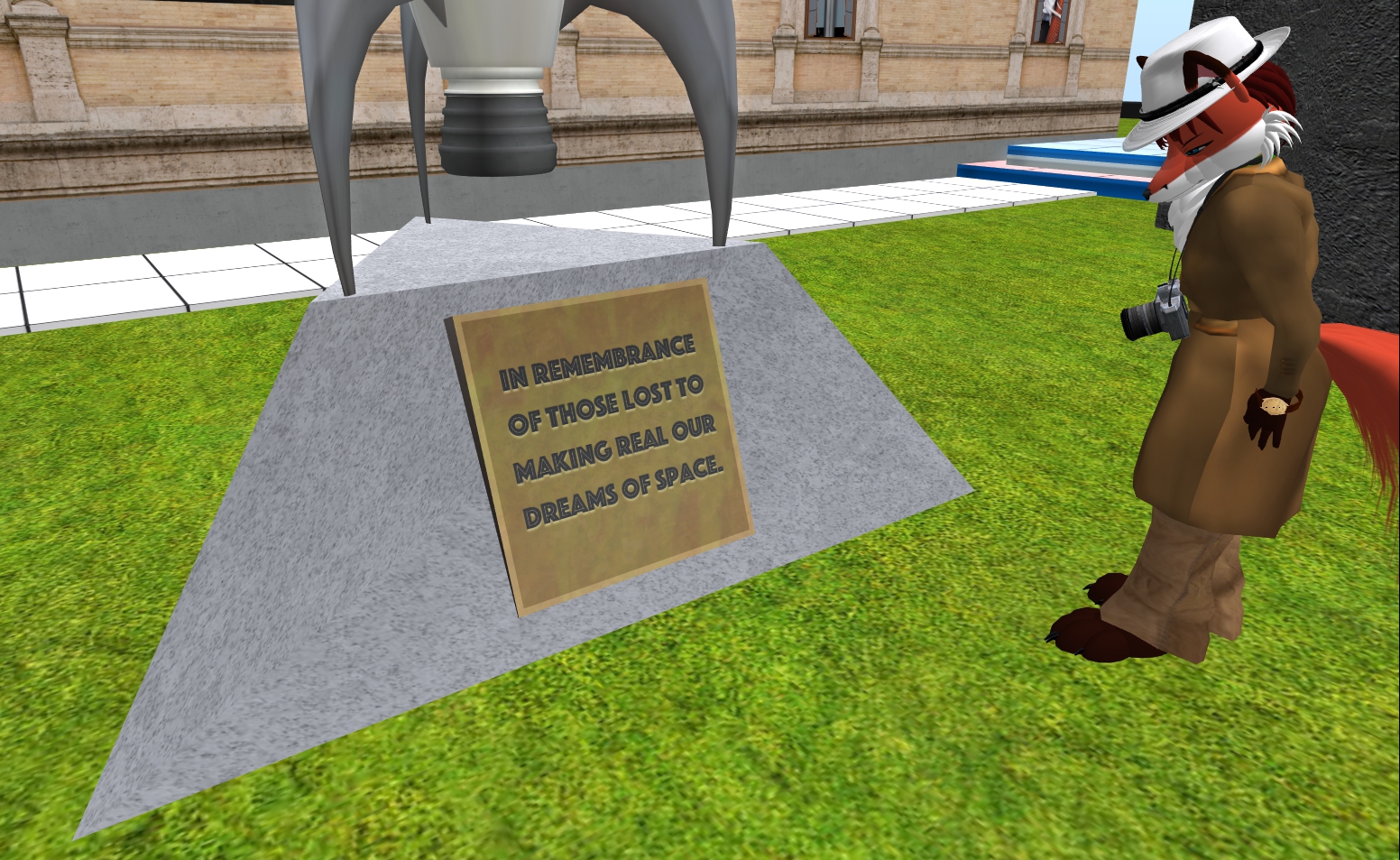
Space Remembrance Day at the National Space Society


By Bixyl Shuftan

Monday January 29 was Space Remembrance Day for the National Space Society in Second Life. The day is one to remember those who gave their lives in Mankind's quest to explore space, notably the Apollo 1 and Shuttle Challenger and Shuttle Columbia disasters. The date was different from NASA's event on January 25 as they didn't announce it until January 23 two days earlier, which was too late for the NSS chapter in virtual reality, "As usual, NASA gave little to know advance warning of their observance, which was last Thursday." So they made plans for their own date. The 29th was chosen as it was the last Monday of the month, they hold regular meetings every Monday, and there was the opinion that future space settlers might make the day a holiday.

The event took place at 4PM, following the NSS's regular weekly meeting, at a location in the NSS sim where several memorials have been placed, large and small at National Space Society (103/124/3005). Some of the conversation was in voice, but Archivist Llewellyn sent the Newser a transcript of the text. Besides the somber remembrance, it was also brought up that this May marks the 60th anniversary of America's first satellite (https://explorer1.jpl.nasa.gov/), "Explorer I ... That was the first successful US satellite launch, and it discovered the Van Allen Radiation Belts around the Earth. It had a highly-elliptical orbit that took it much farther out than the first artificial satellite, Sputnik, launched by the Soviet Union." The music stream had a "special memorial playlist" playing to February 2.

Besides the fallen astronauts, people notable to space whom had passed away in the past year were also mentioned, "We're also looking to include those dreamers, artists, and writers who inspire us. One of them who passed in the last year was Jerry Pournelle. ... Pournelle not only wrote science fiction, but he was one of the responsible parties to bring space defense to the table in the Reagan years, with the 'Citizen's Space Initiative." That had major effects, may have helped lead to the collapse of the former Soviet Union even." "We lost Ian M. Banks sometime ago. he inspired Elon Musk enough that he named his first stage recovery drones after a couple ships from Bank's Culture series." Another mentioned was "Jordin T. Kare (October 24, 1956 – July 19, 2017) was a physicist and aerospace engineer known for his research on laser propulsion. In particular, he was responsible for Mockingbird, a conceptual design for an extremely small (75 kg dry mass) reusable launch vehicle, and was involved in the Clementine lunar mapping mission. Kare was also known as developer of the Sailbeam interstellar propulsion concept and, in the science fiction fan community, as a composer, performer and recording artist of filk music."


There were five former astronauts whom died in the past year mentioned, "We are coming to an era where we can't keep track of the passing of every former astronaut, but this year we did lose four of particular note. Eugene Cernan (March 14, 1934 – January 16, 2017), the last human on the Moon, Paul Weitz (July 25, 1932 – October 22, 2017), Skylab 2 astronaut and Space Shuttle Commander for STS-6, Richard Gordon Jr. (October 5, 1929 – November 6, 2017) Gemini 11 Pilot and Apollo 12 Command Module Pilot, and John Young (September 24, 1930 – January 5, 2018) Most prolific astronaut: longest career, first to fly six missions, only person to fly four classes of spacecraft, and more. Now that we've lost 'the astronaut's astronaut,' it truly is the end of an era." "I think it was said that John Young smuggled in a sandwich to Gus Grissom for the suborbital flight." Also mentioned was "Bruce McCandless II (June 8, 1937 – December 21, 2017). He did a lot of things, but he's probably most recognizable as the first American to leave a spacecraft un-tethered, in the then-new Manned Maneuvering Unit (MMU). The photo of him floating, relaxed, alone in space over Earth, is a classic."

Of America's three space disasters, the Challenger was the one that hit hardest as it was televised live, "I was shaken to my being at the loss of our hopes and dreams down here in the bottom of the gravity well." Of the Apollo 1, someone mentioned, "No one understands the flaw in Apollo One is in everyone's new auto." There was also a quote about the Challenger disaster attributed to me when talking about the 2014 NSS Remembrance Day, "One friend of mine described the Challenger accident as a turning point in his young adulthood, his confidence in the Space Program, in which he saw the future of humanity, had been dealt a blow to the point he would not see it quite the same way again. This is one event serious space fans, and former space fans, in Second Life, might want to check out."

Near the end, Archivist gave the White House's statement of the official NASA Day of Remembrance, "On this year’s Day of Remembrance, we honor the brave men and women of NASA who lost their lives in our Nation’s eternal quest to expand the boundaries of human potential. The dedication and sacrifice of the Apollo 1, Challenger, and Columbia crews, remind us of the true bravery and resiliency of the American spirit, and the challenges we boldly face to reach higher for all mankind. America’s leadership in space is not without cost, but we have met tragedy with perseverance and challenge with achievement. We will not forget the contributions of our great American heroes as we build on their legacy to reach vast and exciting frontiers."

The National Space Society holds meetings every Monday at 3PM SL time.

Transcript provided by Archivist Llewellyn
Pictures from Archivist Llewellyn and Banker Tomorrow

Bixyl Shuftan

Wednesday, January 24, 2018

GeekSpeak Science Discussion: Leaving Earth


On Saturday January 20, I attended the "Geekspeak" science chat and discussion event. For those who don't know, the event takes place about every few weeks on a Saturday at 12 PM SL time, and is hosted by Erik Goff. The event takes place at Danmu (143/127/51).

Usually the topic is a science related one. Among them, how will the development of artificial intelligence affect humanity and society in the next ten to twenty years? Could tapping the large "pool" of magma just under Yellowstone help stave off a massive eruption while at the same time give the United States a large source of energy? What would factories on the moon be like? For last Saturday, the topic was a subject that's been the plot of a number of science-fiction stories, and the preliminary story of a few world-builder computer games: the emergency evacuation of Earth due to an impending disaster.

Let’s suppose we need to leave Earth in a hurry in a few (20? 100?) years’ time.  Maybe because of a nuclear winter, maybe because of an asteroid strike or maybe because the sun is about to explode.  How would we go about it?  Who will we select to go?  Could we, should we, turn anyone away?  If we have to travel for several generations who will be kept in stasis and who will be woken up on arrival?  Who will run the ship?  What animals and seeds will we bring with us?  How will we know what will be needed when we arrive?  Will we bring some animals and plants just because we like them? How will we organise life on the ship so as to keep social structure intact?  And when we arrive at a habitable planet will we dare leave our comfortable ship?  Maybe we will decide that life on an endlessly traveling ship is better. Come and talk with us about our future because, one day, we may need to pack. 

Someone asked about the possibility that politicians might try to keep such a disaster under wraps so only they and a few select friends would be saved. Erik responded, "You would think that, ... but you know, the Internet, everyone, including scientists, are vloggers now. Such a disaster could not be contained ..." Someone else commented, "I'm thinking that an asteroid scenario would be like 'When Worlds Collide.'  We'll send our best in a space arc, and the rabble will try to destroy it at launch, out of envy." And whom would be the colonists? Someone suggested perhaps only women would be selected to double the number of people able to give birth, relying on a sperm bank to have children.

It's a fair guess that if humanity had to pull off such a thing in the near future, it could barely be done and with close to the minimal number of people able to continue the survival of the species. "Could we do it?" Erik asked, "would we be able to build arks in 20 years?" "If we put our minds to it, sure," he was answered by one, "I would say that a concerted effort would do in in six months, tops." "In 6 months we could have a generation ship," someone else suggested. Another was a little skeptical, asking if space travel wasn't such a huge undertaking, why didn't we have men on Mars yet. I suggested that the reason was there had been no large deposits of gold or any other valuable minerals found.

 Reasons for an immediate evacuation wouldn't necessarily be due to nature, but by fellow beings. I recalled a friend's science-fiction story in which the alien race humanity first runs into are in two factions. Over much of the history of their homeworld, there are two major civilizations. One was driven by science and democratic rule. The other was driven by a religion that compelled them to try to conquer the other. The first could beat the second in warfare, but never could convince them to change their ways. Finally once faster-than-light travel was perfected, after the next war the first civilization ordered the people of the second off the planet, many millions ordered into cramped spaceships and shipped to another world.

Erik brought up one interesting possibility. Living in a space ark wouldn't be a comfortable existence. But once people were used to it, would they prefer it to settling on a world? As Erik put it, "would they *want* to live on a planet will all kinds of weird diseases?" Someone commented, "There was 'Orphans of the Sky' by Heinlein, where, at first, when they *finally* arrived at Far Centaurus, they had acrophobia, but it was so much better than the ship, they adjusted. Or at least we are left with that impression, as the story ends with arrival." I brought up in some stories, the colony ship was often the first structure of the colony, and remained the largest one for some time.

And would it be necessary to leave the solar system? Someone suggested a space ark (or a fleet of them) might just hang around until Earth was habitable again. Once you could build a large enough ship that could house a population indefinitely, would finding a colony be such a big priority, "Maybe once you go to the trouble to build a large generational ship that can have a seriously large population, a planet doesn't buy you much." I wondered if someone would bring up the idea of tunneling deep underground and wall-up against any disaster and spend generations in a self-sufficient underground area. But that less romantic idea wasn't discussed. There was one idea I didn't expect that was: what if a colony ship arrived at it's destination, but there was no one to colonize the planet as they had all committed suicide, "speculating on the overwhelming depression that generations of people in a generation ship may feel."

Someone did bring up one topic that I haven't seen in too many sci-fi tales, the idea of large numbers of humans moving to an alien civilization to live. That was a concept I had seen in some stories about the Chakats and their homeworld. But the Chakats did not evolve there; they were a genetically-engineered race created on Earth. The humans were going to a world where the natives spoke a dialect of English.

There were other topics discussed, such as the Metric system and why it wasn't adopted by those stubborn Americans. Eventually, the hour was up, and it was time for me to go.

Bixyl Shuftan

Friday, July 7, 2017

Gentle Heron at the Safe Water Foundation's "Let's Mertalk"


By Bixyl Shuftan

About twice a month, the Safe Waters Foundation hosts a discussion called "Let's Mertalk." Grace Wrigglesworth described the event as, "We mingle every other week ... Sometimes Open Topic, and other times there will be other topics announced in advance. So ask your questions and see amongst all of us to see if we can provide some answers.  Special topic speakers will sometimes answered.  Product demonstrations are welcome - so builders and designers - consider participating." So far, the talks have occurred at the bottom of the Union Passage sim, and take place every other Saturday at 1PM

The Mertalk on Saturday June 10 was a special one as its speaker was Gentle Heron. In the community calendar, Grace described the event as, "This week Gentle Heron will speak about her experiences with helping with SL gateways.  How do new people in SL get introduced to the new environment.  Gentle led the opening of an award winning SL Gateway - come hear more - she will suggest some discussion questions for the mer - and of course we hope you come brimming with questions for discussion as well." Just a few days before, Linden Lab had announced their Community Gateway program was officially back.. So the topic was still fresh in the minds of those concerned about the matter.

I arrived a bit late for the discussion, so missed the first ten minutes. There were a number of people present, most were in merfolk avatars, though there was one other fur and one human. Among those in mermaid tails was Barbie Alchemi of Creations for Parkinsons. So was Any1 Gynoid, whom had written for the Newser in the past and was the one who told me about the talk. Gentle Heron was present in a white Beluga whale avatar. "Try to sit close to the white beluga," Grace told us.

Gentle explained that the "newcomer self-instructional orientation path" was done with the help of some librarians, "specifically designed to help people with disabilities learn to use the virtual world. We call it our NROC, New Resident Orientation Course. It takes up about almost half of the Virtual Ability island, and teaches SL skills such as walking, sitting and flying, text chatting, friending, and joining groups; 'buying' things (for free), finding things in inventory, and unboxing purchases; using maps, landmarks, and teleports to get around; and customizing your avatar appearance and outfits."

Gentle went on, "Virtual Ability specializes in assisting people with disabilities to learn how to function in SL, no matter their capabilities, needs, and use of assistive devices to access their computer." She then asked us what we thought was "the most commonly used assistive technology device." Most of us thought a cane. Any1 guessed eyeglasses, which Gentle stated was the case, "Physical disabilities include paralysis, limb loss, arthritis, neuromuscular diseases… anything affecting the ability to move. This is going to impact typing and mouse use, of course. Many people in our community use some form of assistive technology to use their computer. Some of our members type with a wand attached to a headband. Others type with their toes. Some control the cursor with movements of their tongue, or by sipping and puffing into a tube.  And some folks who are totally paralyzed use their eye motion to control their computer."

Gentle went further, "People with mental and emotional disabilities often need mentors to provide social support. It may take them longer to learn how to function within the social norms of a community. Acceptance of diversity is wonderful. But so is acceptance of community standards. There has to be a balance, and that is aided by patient mentors who guide behaviors. People with developmental disabilities must be protected from some of the more 'adult' activities in SL. Again, patient mentors and guides are an important resource for these folks."

"And finally people with sensory disabilities sometimes need very specialized assistance," Gentle stated, "Deaf people need to have transcribers who type the gist of spoken presentations or classes or discussions so they can participate in text in real time. Of course these text transcripts also benefit people whose first language is not English and people with distractibility problems. They can scroll up in text and review… you can’t do that with audio alone. Blind people can’t access SL through either the Linden or the Firestorm viewer. The Radegast viewer provides text-only access that works with their screen reader software. This allows blind people to participate fully in Second Life despite not seeing their surroundings. ...  In fact, we’ve found that many of the adaptations our community makes for people with specific disabilities often benefit others who do not consider themselves disabled." Barbie commented, "That is why the work that Gentle does is so important and valuable! She helps make SL accessible to everyone no matter what their disability!" "Even if they have fins not legs," Grace, in her merfolk avater, mused. It was brought up that Creations for Parkinsons had a blind DJ (news article). Barbie told the group, "Keao is our friend who has been blind since birth and Gentle has taught her and others how to use the Redegast Viewer so they can enjoy SL!"

Gentle then moved on to Community Gateways, "Our community was invited by Linden Lab to be part of their first Community Gateway program along with several other communities, I think that was back in 2009 or thereabouts, and later to be part of their Resident Help Network program, with other mentoring organizations. That was around 2012. Recently, we’ve become part of the new Community Gateway program. Linden Lab announced that program here: https://community.secondlife.com/blogs/entry/2179-open-the-gate-the-community-gateway-program-that-is/   Now please remember, I’m not an employee of Linden Lab so I’m not an internal expert on the Community Gateways program. I can tell you of our community’s experience. Linden Lab’s emphasis this time around seems to be on newcomer retention. They still are not doing well at keeping a majority of those who enter SL past the first week or month. Too many folks try SL once or twice, then never return."

Raks (rakshowes Resident) commented of most new residents leaving, "That is because the controls are hard at first. Many people I not know helped me in first weeks." Grace commented, "(I) would love to figure out how to make the merfolk community more accessible to those new folk. Not to plan her/now, but just a dream of mine. ...  I wanted to see if others shared my dream- as I can't do all the work myself."

Gentle went on, "Those who stay tend to be those who get involved right away with a community. That realization was the 'AHA' for Linden Lab to re-institute Community Gateways. This program took about a year and a half of planning on the Lab’s part to come to fruition. They did a ton of research. Some of the requirements for becoming a Community Gateway are: • an active community in SL for at least a year and a half, with identified leaders, in good financial and disciplinary standing with LL, • a Full region, with a welcome/orientation area including tutorials and other helpful content for newcomers, and without commercial activity,  • separate land access and resident groups, with the newcomers becoming part of the resident group, • a website with a page that allows account registration through a Linden Lab RegAPI."

Grace stated, "We have this region, (it) is is not an official linden gateway for newcomers. It is a resource center for people interested in being part of the merfolk community, and in good standing with the Lindens I believe - so might be a prospect. But if you go see Gentle's gateway, (it) really has some intensive build requirements." Any1 commented, "I recommend everyone go through Gentle's Gateway... it's an SL ground zero training course... the best that's ever been made." Grace agreed, "Absolutely, it is terrific." Barbie added, "Gentle is my hero! I have the deepest respect for her and the valuable work she does in SL."

Gentle responded, "Thanks for the compliments, friends. I think you will want to hear the rest of this. What does LL offer the Gateways? • They put information about the Gateway communities at their intake areas, both their Orientation and their Social Island areas. • They make the island holding the orientation area free, no tier payments. What you particularly want to remember about the Community Gateways is that they are not a place. They are a process. Not a place! A newcomer welcome and orientation process, beginning at the community’s website and continuing on through an inworld learning experience. For more technical details about the new Community Gateway program, you really should speak with Patch Linden. He's very accessible. The RegAPI on the website was really difficult. It took us many months and much sweat and tears to get it working."

When Any1 wondered why the merfolk community wasn't already doing this, Gentle answered, "You'd need a programmer, not an SL programmer but a website one." Grace then spoke, "Do list, a good team to have. What would be the roles you suggest?" Gentle responded, "It helps to have an educator on the team to write the curriculum. And experienced mentors, as well as sim designers. And those who can make whatever materials your community considers necessary for newcomers, along with website folks, who don't even have to work in SL at all. Then you want to think of ways to advertise. Now, more generally about helping newcomers to a virtual world, I will say that our New Resident Orientation Course planners based their work on the theory of andragogy. You may be more familiar with the term pedagogy, the science of teaching children. Andragogy is the science of adult learning. It’s widely recognized in education that adults learn differently than children. And we are all adults here. I’ll summarize the points of andragogy quickly: • Adults are self-directed as learners. They want to decide for themselves what to learn and when and how to learn it. • Adults have life experiences to draw on. That background provides context for new learning. They can learn from mistakes. • Adults learn as part of their social roles: for work, as students, or for entertainment and relaxation. They learn what they believe is relevant. • Adults learn best by solving problems. You can learn more about andragogy here: https://elearningindustry.com/the-adult-learning-theory-andragogy-of-malcolm-knowles . Please bookmark."

Gentle went on, "We also laid out our orientation using a spiral curriculum, to use another education term. This means the learner uses what they just learned previously in the next lesson. So for example, the first thing people learn on our orientation is how to walk. Then they practice walking to get to the next lesson, on camera skills (looking around). They walk to the third lesson, where they use camera skills to find items to click on. Then they walk to the fourth lesson and look around for items to click on that are pose balls." "Baby steps" someone commented. "Exactly," Gentle responded, "and repeated repetition! See how this is a spiral, and how previous learning is reinforced in each subsequent lesson?" Barbie commented, "It really is an amazing orientation and it is so helpful that VAI offers mentors!"

Gentle then decided to answer questions, saying if anyone wanted to schedule a look at the orientation pathway behind the scene with explanations of the design to contact her after she was done. Grace asked, How did you keep the motivation going? Get people to help?" Gentle answered, "I think you mean motivation of the designer build team. That was not a problem! We all knew how much we got out of being here, and wanted a way for more folks like us to experience the virtual world and its benefits." Grace commented, "Really people involved in getting the effort moving forward. You didn't do all by yourself obviously." Gentle told, "Oh no, it was a whole team. After the community leaders determined this need, we sought out people with the skills needed to make it happen. One of our team members was The Sojourner. Soj was the founder of the first disability group in SL. We also included people as testers. We had low vision folks look at various designs of our signage to see what worked best for them. So no, the team was intentionally planned and recruited. Eme Capalini led that team, and she remains estate manager on that island and several of our other properties."

Raks (rakshowes Resident) brought up, "One of the problems for newbies is that they not know where to go. And if they go to places, often no one is there. This can be a turn off in first days." Gentle answered, "If you mean to get orientation, that's why LL advertises the gateways at their own orientation, and also why the gateway communities have to have an outreach website to do their own advertisement. If you mean that newcomers don't have any idea what they can do in SL, yes, that's often true. It's one of the things our mentors assist with. 'What would you like to do?' 'What would you explore if you had a chance?' " Grace told Gentle, "Raks often meets new merfolk in SL, and a common complaint is they visit the sites and don't find people." Gentle told stated,  "We suggest that people go to *events* not *places,* because people cluster at events." Raks added, "As a newcomer you do not know where to go, how to search, who to ask, it is a totally alien world to you." Gentle nodded, "Yes Raks, so true. But it is like visiting a different country. Guides help!" Grace stated, "We are trying to reform our SWF Concierge team. So welcome and help people when they are here - for events or for when the concierges can be in world." Gentle remarked, "We request that if someone KNOWS they will need assistance (E.g., if they are blind) they write to info@virtualability.org , and we assign someone to contact them, and set up a meeting. We help people even before they are in SL, if they need assistance getting through the sign up process. We work by phone and Skype and in some instances even go to their home if there is a mentor near enough." Grace felt, "We can do similar or adapt some of her approaches. The sea is the limit. I wish we could get a mer avatar into the selections, and Lindens want to start up many more of these gateways, so they get a better start." Barbie thought the idea of a mer as a starter avatar was a good idea.

After that, the chatter went into several other questions and issues. Someone brought up the theory of Climate Change, and felt the community should be involved with the issue, Grace told her this wasn't a political activist group. Barbie commented of mer avatars, "As my 90 Years Young Mom said in the video... she can actually feel her muscles relax and strengthen when she watches her avi swimming as a mer!"

Eventually, the conversation wound down, and people went about their different ways. Later that day was Grace's rezzday party, so there was some preparing for that after the discussion.

The "Let's Mertalk" taking place tomorrow, Saturday July 8 at 1PM, will have Barbie Alchemi as the featured speaker.

Union Passage (96/229/1)

Note: Corrected after someone pointed out a question attributed to her had actually been made by Grace. 

Bixyl Shuftan

Friday, September 16, 2016

Discussing September 11 at Virtual Ability


By Deaflegacy

While the presentation had not begun at the moment, Shyla (KriJon Resident) said that she would put out a prim with the slides, presentation text, and a list of resources. She started it off with introducing herself as Shyla, a PWD.  Shyla explained what PWD stands for, which would be Person With Disabilities. She explained what we would do during the presentation. However, she explained that some of the information in the presentation is disheartening.  She does encourage anyone who becomes uncomfortable at any time to feel free to leave with no need to excuse themselves.

Shyla stated that September 11 is a solemn day for her as well as many others.  Although she was not in New York at the time of the bombing, she knew some people in the towers who did not survive.  For many weeks, she did not know their fate because she worked with them and she did not know their families.

She asked that before we begin, we treat this presentation, and everyone involved, with the respect and dignity that they deserve, "If you do not feel you can do this, I ask that you leave now in respect to the thousands who lost their lives on September 11, 2001 and those who loved and knew them. Thank you."

The presentation began with Shyla explaining that the research could go in several directions.  She had tried to take what is a huge amount of information and put it in a very brief of time, "It is incomplete, with huge gaps in information. Even what we touch on today is, inherently, incomplete." said Shyla.

"First, we will discuss why this topic is important (I believe critical), to both PWD and non-PWD. Then I will share a few of the stories of PWD impacted on 9/11." Shyla said.  "We will discuss the plans that were in place, and in so doing, try to get a glimpse of the mindset at the time by looking beyond 9/11 at other PWD experiences in emergency type situations."

Shyla went on to explain that they will consider the effort to implement changes as it relates to PWD and emergency planning, "We will see things that have not changed. PWD who are present may be very aware of these things, and they are worth writing down in your notecard." said Shyla.  "Finally, I will close with some action remarks about what each of us can do to help move things forward. This will be especially targeted to PWD, and what PWD can do to ensure their safety when plans do not.  We will end with time dedicated to discussion and questions and answers. I will also put out a memorial prim so that people can take copies of this presentation, the slides and a list of citations with links."

Shyla could not remember much about PWD and 9/11. She was not disabled at the time. In 2001 Shyla was recovering from back surgery, but did not consider herself a person with disabilities, "Perhaps this is why I don't remember. PWD were not part of my 'tribe.' Today, I have joined the PWD tribe, as most all of us will at some point. Some sooner, some later. What I can say about joining the PWD community is it wasn't easy for me. I was prejudiced by societal views which have simply turned out to be untrue in so many ways." said Shyla.

With the presentation, Shyla began to look and found their stories difficult to find. This presentation is the result of opening and closing hundreds of web pages searching for them.  Shyla found them on disability sites and in US government reports. She clicked numerous links to archived pages long ago moved or sites long ago abandoned. They were on main-stream media sites, where PWD were primarily un-named sub-characters to their abled-bodied heroes. For an example, 'Heroes saved the woman in the wheelchair.' Shyla found only one main-stream media story which consistently named the PWD saved. "But all the un-named references led to piecing together a puzzle to answer, 'Who were these other PWD?'" said Shyla

"What I share today is important because it is about our narrative, our stories and how often we become 'objects' or 'things' without names. Less than human." Shyla said.  "When we are not human, there is less need to plan for us, as we shall see. It is imperative this change for PWD today and in the future. Why?"

Shyla talked about how the natural disasters have been on the rise from 2000-2009, it being three times more than from 1980-1989.  Most were related to weather, "As you listen to the stories of PWD, please know there is a concept in emergency planning which asserts that not all disasters are natural; most are the result of human error." said Shyla. "Emergency planners are faced with determining how ready they can be given budget and resource constraints. This leads, inevitably, to decisions which value some lives more than others." Shyla hopes to show that this planning limitation need not impact PWD as greatly as it did in 2001, nor as it often still does today.

Shyla showed a slide of the World Trade Center Memorial and Towers in memory to the approximate 200 PWD's who died on 9/11 whose stories could not be found. "Of the close to 3,000 deaths related to the terrorist attacks of 9/11, some 200 are estimated to be PWD." said Shyla.  "If 200 were PWD, I could only find two of their stories. For the rest, the narratives are vague or broad and lack specificity. But we know they perished. We know because we found their wheelchairs, or they were identified through forensic means as PWD."

They know because of the stories of some able-bodied people who survived. There are stories like the man who said his last image of the 80th floor as he began his descent was of people in wheelchairs and with walkers waiting to be rescued, "No emergency responder made it as high as the 80th floor. Orio Palmer, a New York firefighter who died that day, is thought to have reached the highest floor that day. He reached Floor 78." said Shyla.

However, Shyla did find two stories of two wonderful people.  The stories would be of Colleen Fraser and Ed Beyea. Colleen Fraser was on Flight 93 when it crashed in a field in Pennsylvania, "Her legacy is one of strong community commitment. She had been recently appointed to Chair of the New Jersey Council on Developmental Disabilities. She was flying to attend a work related workshop on 9/11.  Her life was spent working to get people with developmental disabilities out of state run institutions and integrated back into their communities. She played a significant role in altering the state of New Jersey's attitude and service concepts toward the developmentally disabled. She was a strong, vocal advocate of the ADA and present at its first congressional hearing. She worked vigorously to improve women's health-care." said Shyla.  "I suspect, if she had been asked the day before 9/11, she would have shared a plethora of goals and work she had left to do. On 9/11, she was 51 when Flight 93 crashed."

Shyla went on to tell Ed Beyea's story, "The mainstream media spoke of him mostly as 'the man in the wheelchair'. Ed was 42 and became quadriplegic as the result of a diving accident when he was in his early twenties. He mastered an oral joystick well enough to land a job as a data entry clerk for Empire Blue Cross/Blue Shield in the World Trade Center." said Shyla.  "On the day of the attack, as many of his co-workers exited, his friend Abe Zelmanowitz stood by him as Ed declined a stranger's help down the stairs. Ed was worried his weight would make it difficult for untrained persons to transport him without breaking any of his bones. Ed opted to stay and wait for help."

"Also with him that day, as she usually was, was Ed's aide Irma Morant. The three agreed Irma would head down the stairs and relay Ed's location to an emergency responder so they could come help." Shyla continued. "Abe stayed, refusing to leave Ed's side, as Irma headed downstairs. She did locate firemen and relayed his location and advised he would need oxygen due to the dusty conditions. Then Irma exited the towers to safety. Meanwhile, at Ed's side, Abe spoke to loved ones over his cell phone. They begged him to evacuate, but he would not leave Ed alone. Abe and Ed had been friends for twelve years. They were sure help would come. It never did. Both Ed and Abe died when the towers collapsed."

Shyla pointed out that there are more stories available about those who survived. But even so, only one main media story repeatedly gave the PWD's name, "That is the story of John Abruzzo. John is sometimes referred to as 'a man in a wheelchair', but more often his story provides his name, and those of one or more friends who helped save his life. John survived the first World Trade Center bombings in 1993. He remembers it took hours for him to evacuate the towers that day, with the help of friends. Sometime after the 1993 bombings, an evacuation chair (evac-chair) was placed on John's floor. Although reports vary, John's own words indicate neither he, nor his friends, ever practiced using the chair, but he knew it was there." said Shyla.  "He is not sure how evac-chairs were distributed in the towers, just that he had been provided one. On 9/11, he and his friends and co-workers figured out how to strap John into the chair and began to descend the stairs.  Their stories reveal the evac-chair didn't always fit easily through all the corridors. It was hard work. Still it was better than in 1993. When they reached one of the lower floors, they found a triage unit. Workers there told John's friends they could leave John there. His friends refused.  John was carried down the remaining floors. What took hours in 1993 took only 90 minutes in 2001 with an evac-chair. When they exited, John was placed in an ambulance and whisked away.  His friends were caught, minutes later, in the debris of a falling tower. They ran for cover. Ed and his friends and helpers all survived."

"Without an evac-chair, they would not have been able to descend as fast and would have perished." Shyla said.  "Had John been left at the triage unit, he would not be with us today either. All those at the triage unit died on 9/11 when the buildings collapsed on them."

"There was the woman in the wheelchair who was saved by Michael Benfante. Michael was repeatedly named in articles and interviewed often on his own. But the woman had a name and life too. Tina Hansen had juvenile rheumatoid arthritis and used a lightweight wheelchair at work, just in case she had to be evacuated. She, too, had been provided an evac-chair, but forgot it was under her desk. Two co-workers, Michael and another person, assisted Tina down the stairs that day, ensuring she survived." said Shyla.  "Tina participated in post-9/11 government assessments and shared her employer, the Port Authority, did not practice fire or emergency drills. The Port Authority is a government agency working jointly for New Jersey and New York. They oversee transportation services in the area of the Port of New York and New Jersey.  Tina is not sure why she forgot she had an evac-chair in some interviews, but in one government report she cites the lack of drills as one reason she may have forgotten it was there, right under her desk."

"Tina appears to have been very hesitant to seek public acknowledgment of her experience on 9/11, one reason her story and name may have been missing from main-stream media reports." said Shyla.

The next slide as about two blind men who received media attention when they survived. The media referred to them mostly just as 'a blind man' or 'the blind man on the 68th floor'. "We shall see later, these two men were not the only blind and low-vision PWD who survived that day. But they are the two who receive broad media attention after 9/11. Omar Eduardo Rivera was the blind man on the 68th floor. When I looked for his picture online, I found it was often confused with the other blind man in the media, who we shall hear about next." Shyla said. "Omar did not think he could get down 68 flights of stairs on his own. He released his guide dog, Dorado, so the dog could survive. At first he heard Dorado running away, but then Dorado stopped and returned. The dog nudged Omar's leg and refused to leave without him. It was enough to encourage Omar to attempt the descent.  Along the way he met a co-worker who helped him make it down the stairs. Omar, his service dog and the co-worker all survived.

"The other blind man was Michael Hingson. His story is very different in one-way from those we have heard so far. Michael was on the 78th floor of the Towers.  In his case, his employer held regular fire and emergency drills. He recalled this made him feel empowered and prepared for an emergency.  When the decision was made to evacuate, Michael and his dog, Roselle, knew what to do and how to do it. He credits this as life-saving information." said Shyla. 

One thing Shyla didn't expect was the stories of PWD impacted by 9/11 who were not in New York, not in Washington DC and not on one of the hijacked planes, "Their stories are important too, for they remind us that what happens one place can have a huge impact much further away." said Shyla.  "Take Brian Cortez. Brian had been fighting for a heart transplant. He was rejected as a viable candidate because he was deaf and disabled.  His family, friends and even teachers fought to get Brian on the transplant list, and finally the decision was overturned and he was put in queue for a transplant."

"Shortly after the attacks on the twin towers, but before the Federal Aviation Administration (FAA) began to allow planes to fly in the states again, a heart match was found for Brian.  The heart was in Anchorage, Alaska, but Brian was in Seattle, Washington. With planes grounded, there was no way to get Brian the heart he desperately needed. Brian was running out of time." said Shyla.  "After intense negotiations, the FAA authorized a small plane to fly the heart into Seattle. Brian received the transplant and survived.  Let me add, nothing about Brian's condition prevented him from understanding or following care instructions."

Shyla started talking about the plan in place, "This slide has strong words, PWD words -- strong, honest and to the point...” said Shyla, "The first are from Dave Hinsburger, who writes a PWD blog in Canada which has received numerous awards. He writes: It's just outside my door. The gathering place. The place where those of us with disabilities are to go in a crisis. Should there be a fire, an earthquake, a disaster of any kind, it is where we who move differently, who move mechanically, who move assisted are to wait.  I have been aware of this place, and places like it, for my entire existence as a person with a disability. On moving in to my apartment, a high rise, I'm told about it as I sign the lease. I'm smiled at. People are pleased that there is a plan."

"People want me to be grateful for the plan. Grateful that I have been thought about. But I haven't." Shyla continued.  "9/11 taught me that.”

Shyla talked about a blog called Reunify Gallery. They write: "The plans others make for us (meaning PWD) are usually not going to be as good as the plans we make for ourselves–especially if you are a person with a disability.”

“After the 1993 bombing of the World Trade Center, there was agreement a plan was needed for PWD, but the effort was fragmented at best.  The final plan, of which I could not find documentation, was in part poorly communicated and in part lethal.  This is not an opinion, it is well documented in government reports as well as the events and narratives available from 2001.  Somewhere between 1993 and 2001, much of the effort to include PWD in emergency planning for the World Trade Centers lost traction.  Not just from within the government, but from within the PWD community as well. For example, although there were evac-chairs in the towers in 2001, I could not figure out who purchased them or when. Some information suggests each tenant made an independent decision about whether to purchase such chairs for the floors they occupied. Other documents suggest evac-chairs were purchased by building management for all floors."

Shyla went on to explain that Ed Bayea's employer Empire Blue Cross/Blue shield insists they purchased an evac-chair in 2000, a year before the 9/11 attacks. But, Irma Morant, Ed's aide, insists there was no chair, and even if there was, she believed only the fire department was trained to use such equipment. "In contrast, John Abrezzo and his friends used an evac-chair with no training and without concern about "who" was authorized to use such equipment. Even today, whether evac-chairs are for lay people or emergency responders creates debate. So it is not clear whether evac-chairs were part of a "plan" by building management or were provided as part of individual tenant plans."

Shyla said that the same is true for fire and emergency drills. Michael Hingson's story is one of preparedness through his employer's conducting of such drills, "I found no evidence that any other PWD participated in such drills, except one, The Associated Blind, whose story I found in a government report, not media reports. The Associated Blind not only conducted fire and emergency drills for their mostly vision impaired staff, but they coordinated with building management and the New York Fire Department. On 9/11, all of The Associated Blind's 9th Floor employees successfully evacuated the Twin Towers." said Shyla. "Reports indicate their employees were calm, much like Michael Hingson. This is credited to the drills these employers held."

"In 2001, however, the primary plan appeared to be that PWD were to make their way to a designated gathering place and wait for help.  All PWD who followed these instructions perished when the towers collapsed on 9/11.  If there are thoughts that 9/11 was such an extreme event, and that a gathering place works better in other situations, consider these stories." said Shyla.  "(Sadly, most of these narratives provided no names, though many are a part of government reports.)  A government report cited the experience of a woman in a wheelchair with severe rheumatoid arthritis. While at work, a bomb threat was received and she was told to stay put and help would arrive. The woman waited. After some period of time and out of sheer fear, she self-ambulated herself out of the building. No one had been tasked to help her or seemed aware she was in the building."

Shyla went on to explain that another PWD reported their workplace lost electricity and lights. The PWD felt they could ambulate down the stairs but asked if someone could take their wheelchair.  "Citing liability concerns, the request was denied and the PWD was told to wait and someone would come to assist." said Shyla.  "After two hours under emergency lights, the electricity was restored. No one ever came."

Shyla had found numerous stories like this, some with more disturbing outcomes. She believes that gathering places are not really an answer -- they simply allow those creating emergency plans to feel they have included PWD. "Gathering places pass the buck to an unknown entity to be responsible for saving PWD, and often that unknown entity is not informed of this expectation. But there are several take-aways form PWD stories of 9/11. Some very good ones. The first is drills work."

"PWD on 9/11 who participated in drills that led them not to gathering places, but rather to fully exit the buildings, survived. Beyond this, PWD who participated in drills reported being calm, feeling self-sufficient and confident of their ability and what they needed to do. But we know of only two employers who held such drills. If we move beyond 9/11, we hear other stories of grave concern surrounding drills."

"PWD still report emergency plans and drills which ask them to engage in actions they cannot perform. For example, some PWD cannot walk, crawl under a desk, stop, drop and roll, or use stairs instead of elevators.  Paul Ray, a quadriplegic, reported when he worked for Ford Motor Company in Dearborn, MI, he participated in his first emergency drill 18 months after being hired."

"Working on the third floor, and being unable to use stairs, Paul went to the elevators. The volunteers redirecting people to the stairs were surprised to see him, had no plan for him and were not sure what to do.  Paul also said he had never seen an evacuation plan prior to that drill."

"A social worker in New York City who uses forearm crutches to ambulate was in a high rise visiting a client when they had a drill. The plan did not include PWD, so they asked her to simply not participate in the drill."

"A PWD in Oklahoma reported there was a fire in their building and there was no plan for their evacuation.  Afterwards they requested the employer include them in the plan, but the employer refused to update it.  It is against ADA requirements to not include PWD in evacuation and emergency planning. Sadly, however, this is rarely enforced for various reasons, not the least of which is many PWD never file complaints in this regard."

"A 2005 National Council on Disability briefing found PWD do NOT make formal complaints about discrimination in emergency or disaster planning. They also found the impact to PWD in emergencies is far greater than the number of complaints reflect. From personal experience, I have had employers who do not update plans because they do not know how to effectively provide for the safety of their employees, PWD or not. This is also not considered 'reasonable' under the law and does NOT protect employers from liability."

Our second valuable lesson surrounds communication. The National Council on Disability has worked diligently since 2005 to increase the availability of PWD emergency planning communication on all levels. PWD, employers, community based organizations, emergency planners and responders, government organizations, etc., all have more information available than ever before. On the other hand, the NCD has recommended government sites provide PWD communications in a variety of formats other than .pdf, including audio. For the most part all reports and planning information I researched is still only available in .pdf on government websites. Worse, some appear as in this blue box. A .pdf image which is scanned improperly. In this case, both selections have the world 'disabled' in them.  But as you can see, what they are attempting to communicate is illegible.  Communication progress has been made at Disaster Recovery Centers. All are now supposed to include a sign language interpreter on-site or via remote video. They are also supposed to have caption amplified phones, amplified personal listeners and emergency information available in braille or audio. This highlights another issue during the events of 9/11. Live closed caption services suffered due to the stress of the situation and long hours of coverage.  The result was many deaf people across the country had to unscramble words, sometimes key words, to properly interpret information."

"Some stations showed images of the towers on fire or collapsing without any closed captioning. Imagine seeing these events live with no explanation of what is happening. On the opposite end, some stations had text, but no audio, leaving low-vision and blind people unaware of the events if they were tuned to such a station. Although New York had a reverse-911 telephone system which could call 1000's of person with emergency information, even TTY, it was not used. I found no explanation as to why, and the various reasons some things were done or not done are too numerous to hazard a guess. Most importantly, as long as PWD are not integrated into drills and communication efforts, such events are likely to reoccur."

"Finally, I read hundreds of pages of reports on emergency planning for PWD and other at risk communities, such as children and the elderly. The good news is the PWD community is being engaged more and changes are being made. Sadly, there is more discussion than action. This is often true, and PWD are no exception. The result, however, is it has been 15 years since 9/11, and still many PWD are told to wait for help. To go to the gathering place.  There is much PWD can do to change this."

"PWD must ask to see the plans that are in place in their own communities, work places, rentals and ensure they have a plan of their own for their residence. PWD must identify deficiencies, assist in resolution and report when such requests are ignored or denied. Many PWD in the twin towers changed things after the 1993 bombings. Tina Hansen got a lightweight wheelchair which she always took to work."

"9/11 caused many PWD to change even more…Many considered their place of residence and determined how they would escape without assistance in case of an emergency. Some established plans with friends, neighbors and co-workers. And for some, these worked on 9/11. Some decided it was not worth being polite in an emergency. They decided they would yell, scream, make whatever ruckus necessary to ensure their survival. Some became advocates of planning, working hard to ensure plans included their particular needs in realistic ways.
 
Ultimately, there is a societal and legal responsibility to include PWD in emergency planning and resources to help make this happen. Sadly, these resources vary from location to location, so I cannot list them all here. But you can Google them. If you can't find them, reach further and ask, Ask ASK for them!"

"I'd like to open this up to discussion, but before I do, I will say again, finding these stories was not easy. They weren't there front and center. I will guess you have all had some thoughts today, some memories or identification of some sort. I challenge all of you today to write to write about it a bit. This is your story, your narrative, and your VOICE matters. Then look for one person you can share it with.  Just one person will be one more that has heard your story than before. If all PWD did this today, millions would hear our stories who had never heard them before."

"Before opening to discussion and question and answers, I ask again that the guidelines presented at the beginning of this presentation be kept in mind. Questions are welcome – there was much information I could not include in this time allotted. Please feel free to share your thoughts. The goal is to promote thought – therefore there is no need to debate. We can consider our position on various thoughts independently while maintaining a supportive environment. Let us be respectful of the memory of those lost on 9/11, as well as the many people alive today, some possibly here, who knew them. Let us be respectful of each other." 

Before Shyla started the discussion, she asked if we have someone who can type of someone who voices. Vulcan Viper and Zip Zlatkis stated that they could try. Then Shyla started the discussion and Q&A. It was then agreed that Zip Zlatkis would type of someone who voices.

The audience agreed that Shyla did a great job of doing the presentation.  They thanked Shyla for the presentation.

Gentle Heron spoke up about her personal story to share, "I have a personal story to share. Not as exciting as what you have shared Shyla. You did an amazing amount of research! My story explains why this topic is so important to me.  Many years ago, when I was still able to be employed and walked slowly on crutches, I worked on the top floor of a building." said Gentle Heron.  What I was supposed to do in emergencies was exactly as Shyla stated—wait in a “safe area” at the top of the stair tower. When I knew it was a drill, I waited…and nobody EVER came (or waited with me). One time, it was not a drill. There was a fire in a floor below ours. We could smell the smoke on our floor. I decided not to wait, but when nobody else came down the stairwell from my floor, I bumped down the stairs on my butt to the next floor, where I waited until nobody else was coming out of THAT floor.
 
I did finally get to the bottom…without my crutches. I sat on the bottom step and waited to see if anyone would come to help me. I was discovered still sitting on that step when the fire had been put out and everyone was returning to the building.  From that time on, I have been a big advocate of personal and institutional preparedness."

Shyla thanked Gentle Heron for sharing her story with the audience, "And Do1 Thing was a great program in this regard." she spoke.

"I seen one thing one time." said Lukey Woodget. "It was an invention. It was a tube made from material. At intervals there was elastic." Vulcan Viper thinks he's seen the same thing in The Netherlands. Lukey  continued to explain that it slows us down, "It could be deployed at any height and you just jump in it and slide right down the building. It was quite safe." Lukey doesn't know what happened to the idea.

Sister (sister.abeyante) appreciated this quote (from the Reunify Gallery blog): "The plans others make for us are usually not going to be as good as the plans we make for ourselves..." (Reunify Gallery) Self-responsibility is empowering in itself. Whether we do that in the moment (i.e. deciding, when our service animal encourages us, to make an attempt) or in preparation (our own or with others).... it is up to us. Self-preparation, self-drills, self-planning-really, this is a clear call for leadership...OUR leadership....in terms of both organizational and personal preparedness." Shyla thanked Sister.

Gentle Heron came up with links for evac chairs: http://www.evac-chair.com/ and escape chutes: http://www.escape-chute-systems.com/ She explained those links are commercial sites  "I have absolutely no faith in the govt or anyone else helping me in an emergency. I think it's a good idea to try to have your own plan to help yourself.  There's probably a lot of Survivalist type websites with some ideas." said Ruby Vandyke.

"I have encountered the response "it's too expensive to provide that" when I have asked about plans or modifications." said Sister.

"Sister, it is required by ADA, and you can file a complaint if emergency plans are not updated to include PWD." said Shyla.
 
"Oh! and I think one of the blind men who escaped the Towers on 9/11 spoke at one of the Helen Keller sessions here in Second Life." said Gentle Heron.

"Likely Michael Hingson." Zip Zlatkis typed.

"And Gentle, that was likely Michael Hingson, who speaks professionally now about his experience." said Shyla.

"Yes I think so...” said Gentle Heron.

Lukey Woodget agreed, saying, "Yes I think that was it the Escape chute."

Sister (sister.abeyante) nods, but is aware of the expense of filing an ADA complaint (time and attorney fees), too.

Gentle Heron had a question: "This session is good awareness and the info needs to be shared with everybody we know...but what else can VAI do to help each of us individually prepare?"

"Maybe brainstorm sessions? For specific situations?" said Jadyn Firehawk. "People bring their specific situation."

"Shyla, I think there are a lot or resources on the notecard." Zip Zlatkis typed.

"And everybody brainstorm." said Jadyn Firehawk.

"Shyla, another thing to think about is there are a huge number of resources and links on the notecard Shyla, I did find in many of them there were things I could do even if no one else did." Zip Zlatkis typed. 

Sister (sister.abeyante) noded, "That's the self-responsibility piece-so important." said Sister.

Rielyn Lane had a question, which was "what about plans for those who are chronically ill and could not manage at traditional emergency shelters?"

Shyla asked Doc Neuro Cyants (ecoli.gynoid) if she can post his notecard, and Doc Neuro Cyants said yes.

Zip Zlatkis continued to type for Shyla, "Shyla responds to Rielyn.  There were many reports in shelters that PWD were turned away because they were seen as drunk instead of disabled. There are many reports...there are organizations working on memorandums of understanding for information to the shelters where this takes us, we have yet to see."

Shyla spoke for Doc Neuro Cyants, "This has been extremely insightful.  So well researched and exposed me to many issues I simply have not thought about.  I should add, that I just spoke to my daughter, who is a designer for commercial interiors.  Luckily, I actually recorded this, so she is going to listen to it and then share with her team of designers. Thank you so much. doc"

Gentle Heron said it was a wonderful dissemination. Shyla said it is wonderful.

Vulcan Viper wanted to know if Doc Neuro Cyants recorded the event and added that it's the part of what AIM is about. Zip Zlatkis typed, "This idea that the mainstream media often refers to PWD as sub characters. Any media outlet needs to get an actual name for "the blind man on the 68 floor", this humanizes us.  I love John's story because he shares story everywhere. He is a special friendship and a commrad eand makes him human."

Zip Zlatkis then typed, asking if there is anything else to share.

Vulcan Viper shared his notes with Shyla.

"See if your state has a FAST (Functional Assessment Service Team) program. I know CA and WI do. The team is trained to help "people with access and functional needs" during emergencies and disasters." said Gentle Heron.

Zip Zlatkis typed, "It was not just disability things that were not legible."

"A legible one, I hope!" said Vulcan Viper.

Before ending the presentation, Zip Zlatkis typed, asking if there is anything else. When there was none, Shyla showed the next slide, which shows the resources that she used for the presentation. She also said that she is also putting out these towers which includes this script as well as a notecard with these citations.

"Thank you for letting me share this today." said Shyla, before ending the presentation.

The Landmark for the site is Tenerife (118, 143, 1343)

"That is the 9/11 Memorial - Always Remember, Never Forget." said Shyla. 

As I sat back in real life as people started to leave the place one by one, I am deep in thoughts especially by what Shyla had said throughout the entire presentation. We have been scarred ever since this tragic day. The best we can do is make things better for PWDs. In doing that, we would be making a step forward for a better and safe future for every one of PWD. For that, I thank Shyla.
 
Deaflegacy